Reference: Dubai Municipality Technical Guidelines for the Safe Handling of Asbestos (DM-HSD-GU50), read together with Dubai Municipality demolition permit and HSE requirements and the Dubai Integrated Waste Management framework.
Most property owners in Dubai think demolition starts with a machine and a permit. For older buildings, it actually starts with a survey. If a structure was built before the early 2000s, Dubai Municipality expects a pre-demolition hazardous material survey — including an asbestos survey — to be completed before the structure comes down. Skipping this step is one of the most common reasons demolition projects in Dubai get delayed, fined, or stopped on site.
This 2026 guide explains what the survey is, when it applies, how asbestos and other hazardous materials are removed and disposed of, and how Al Zelzal Demolition Works LLC keeps your project safe and compliant from day one.
Why Asbestos Is Still a Real Issue in Dubai
Dubai’s biggest construction boom ran through the 1980s, 1990s, and early 2000s — exactly the period when asbestos-containing materials (ACMs) were still widely used in the region. Many older villas, warehouses, shops, and commercial buildings across Dubai still contain asbestos today.
Common places asbestos shows up in older Dubai buildings:
- Cement roofing sheets and corrugated panels
- Ceiling tiles and textured ceiling coatings
- Pipe and boiler insulation (lagging)
- Vinyl floor tiles and the adhesive beneath them
- Gaskets, sealants, and some wall boards
The problem is fibre release. While asbestos sits undisturbed, it is relatively low risk. The moment you start breaking, cutting, or knocking down a structure, those fibres become airborne — and Dubai’s heat and humidity can speed up the breakdown of old materials. That is why a survey has to happen before any demolition, not during it.
Older areas where this matters most: Deira, Bur Dubai, Karama, Satwa, Al Quoz, Al Qusais, Muhaisnah, Jumeirah, Umm Suqeim, Al Wasl, Al Safa, Mirdif, and Al Warqa, along with older warehouse plots in Ras Al Khor and Al Quoz industrial.
What a Pre-Demolition Hazardous Material Survey Covers
A pre-demolition survey is broader than just asbestos. It is a documented inspection of the building to find anything that needs special handling before general demolition begins.
A proper survey typically checks for:
- Asbestos-containing materials (ACMs) — identified by sampling and laboratory analysis
- Lead-based paint — common in older coatings
- Chemical and fuel contamination — relevant in workshops, industrial units, and warehouses
- Refrigerants, oils, and tank residues — from old AC systems, generators, or storage tanks
- Structural condition — load-bearing elements and demolition sequence considerations
The deliverable is a written report. Where asbestos is confirmed, that report drives the removal method, the containment required, and the disposal plan — all of which feed directly into your demolition method statement and permit application.
When the Survey Is Required
As a practical rule for Dubai in 2026:
- Pre-2000s buildings — a hazardous material / asbestos survey should be treated as mandatory before demolition planning.
- Renovation and partial demolition — surveys are equally relevant, because cutting into ceilings, walls, or services can disturb hidden ACMs.
- Fire-damaged buildings — fire can liberate asbestos fibres from materials that were previously stable, so a survey is essential before internal strip-out.
- Industrial and warehouse units — these add chemical, fuel, and contamination checks on top of asbestos.
Newer buildings constructed well after asbestos was phased out carry far lower risk, but a survey still protects you by documenting that the site is clear.
The Asbestos Removal Process (Step by Step)
If the survey confirms asbestos, removal must be completed and the area cleared before general demolition starts. The work has to be done by a Dubai Municipality–licensed asbestos removal contractor, under proper supervision.
1) Assessment and sampling
Certified inspectors take bulk samples and carry out air monitoring to confirm the type, condition, and extent of the asbestos.
2) Containment
The affected area is sealed off so fibres cannot escape into neighbouring spaces or to the public during removal.
3) Controlled removal
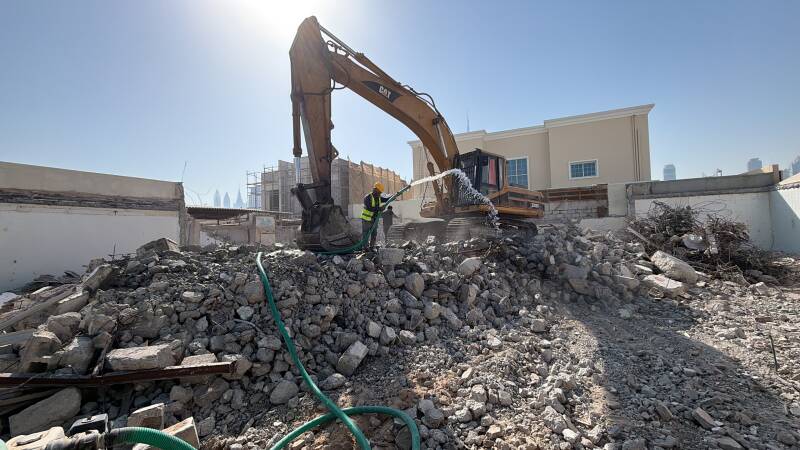
Wet stripping methods are used to keep fibres from becoming airborne. Dry removal is avoided wherever possible because it releases far more dust.
4) Packaging and labelling
Asbestos waste is double-wrapped, sealed, and clearly labelled as hazardous so it cannot be confused with general demolition debris.
5) Approved disposal
Asbestos and other hazardous waste are transported by licensed carriers to a Dubai Municipality–approved hazardous waste facility — the Jebel Ali Hazardous Waste Treatment Facility (JAHWTF) — not to a normal landfill. Transport is tracked, and the load is verified on arrival.
6) Clearance
Air sampling must show fibre levels below the regulatory threshold before the containment is dismantled and the area is signed off as clear. Only then does structural demolition begin.
What Happens If You Skip the Survey
Trying to save time by going straight to demolition usually costs more in the end. The realistic risks include:
- Demolition permit delays or rejection, because the method statement is incomplete
- A stop-work order if hazardous material is discovered mid-demolition
- Fines and compliance violations under Dubai Municipality HSE rules
- Health exposure for workers, neighbours, and the public
- Contaminated debris that an approved facility may reject, forcing rework
- Knock-on delays to your demolition completion certificate and site handover
In short: the survey is cheaper than the consequences of not having one.
What Property Owners in Dubai Should Know
Before hiring a contractor for an older villa, warehouse, shop, or commercial unit, owners should confirm the contractor will:
- Arrange a pre-demolition hazardous material and asbestos survey where the building age requires it
- Use Dubai Municipality–licensed specialists for any asbestos removal
- Include hazardous material handling in the demolition method statement and risk assessment
- Dispose of hazardous waste only at approved facilities, with proper tracking and records
- Coordinate this work alongside utility disconnections (DEWA, du/Etisalat) and the demolition permit
Choosing a contractor who treats the survey as optional is exactly how projects end up with delays, violations, and surprise costs.
How Al Zelzal Demolition Works LLC Handles Hazardous Materials Across Dubai
At Al Zelzal Demolition Works LLC, we plan demolition the right way — starting with the site, not the machine. For older buildings, that means identifying hazardous materials early, coordinating licensed removal where needed, and building it all into a compliant method statement before work begins.
Our Service Areas:
Deira, Bur Dubai, Jumeirah, Umm Suqeim, Al Safa, Al Wasl, Al Barsha, Mirdif, Al Warqa, Al Khawaneej, Nad Al Sheba, Arabian Ranches, Dubai Hills, Palm Jumeirah, Dubai Marina, JVC, JVT, The Springs, The Meadows, Al Mizhar, Al Twar, Muhaisnah, Al Qusais, International City, Dubai Silicon Oasis, Al Quoz, Ras Al Khor, Meydan, Dubai South, and surrounding areas.
Our Demolition Services Include:
- Villa demolition in Dubai
- Building and warehouse demolition
- Partial and internal demolition
- Pre-demolition site assessment and coordination of hazardous material surveys
- Structural dismantling and concrete breaking
- Excavation and site clearance
- Debris hauling, waste segregation, and approved disposal
- Controlled demolition
Our approach ensures:
- Early identification of asbestos and hazardous materials
- Coordination with licensed removal and disposal specialists
- Compliant method statements and risk assessments
- Public, worker, and neighbour safety
- Dust and debris control
- Clean, certified site clearance
Related Demolition Guides You Should Read
- Villa Demolition Method Statement & Risk Assessment in Dubai (2026) — method statement and risk assessment
- Demolition Permit Process in Dubai – Step-by-Step Guide (2026) — demolition permit process in Dubai
- Pre-Demolition Checklist for Property Owners in Dubai (2026) — pre-demolition checklist
- Dubai Municipality Circular 2026 for Demolition Contractors | Safety Rules — demolition safety rules in Dubai
- Demolition Completion Certificate in Dubai Municipality (2026) — final inspection and site clearance
Frequently Asked Questions (FAQ)
Is an asbestos survey mandatory before demolition in Dubai?
For older buildings — generally those built before the early 2000s — yes. A pre-demolition hazardous material and asbestos survey should be completed before demolition planning, and it forms part of a compliant method statement.
Can demolition start before asbestos is removed?
No. Where asbestos is found, it must be removed, the area cleared, and clearance confirmed before general demolition begins.
Who is allowed to remove asbestos in Dubai?
Only Dubai Municipality–licensed asbestos removal specialists, working under proper supervision and following approved methods.
Where does asbestos waste go?
It is double-wrapped, sealed, labelled, and transported by licensed carriers to a Dubai Municipality–approved hazardous waste facility — the Jebel Ali Hazardous Waste Treatment Facility (JAHWTF) — not to a regular landfill.
Does my newer building need a survey too?
Risk is much lower in buildings constructed well after asbestos was phased out, but a survey still provides documented proof the site is clear and helps avoid permit questions.
Does Al Zelzal handle this?
Yes. We assess the site early, coordinate licensed surveys and removal where needed, and integrate hazardous material handling into the demolition plan across all major Dubai areas.
Final Thoughts
For older buildings in Dubai, safe demolition begins long before the first wall comes down — it begins with a survey. Identifying asbestos and other hazardous materials early protects your workers, your neighbours, your permit, and your timeline. Whether your project is a villa in Jumeirah, a warehouse in Al Quoz, an old building in Deira, or a shop fit-out in a commercial area, doing the survey properly is the difference between a smooth, compliant demolition and a costly one.
Contact Al Zelzal Demolition Works LLC
🌐 Website: https://www.zelzaldemolition.com/
📞 Phone: 0567800464
📍 Google Maps: https://maps.app.goo.gl/ffE89hcSjJTycAJa9
Add comment
Comments