Introduction
When property owners and engineers plan demolition in Dubai, the standard permit checklist is well known — DEWA disconnection, Etisalat and du NOC, RTA road permits, and the Dubai Municipality demolition permit. Most contractors handle these routinely.
But there is one additional RTA approval that catches many people completely off guard — and it is not limited to one area, one rail line, or one type of project.
The Railway NOC.
This applies to both the Dubai Metro and the Dubai Tram. The Metro Red Line and Green Line together cover a significant stretch of the city, and the Dubai Tram runs through the Marina, JBR, Al Sufouh and Media City corridor. Elevated columns, station structures, tram tracks, underground rail utilities, and rail-related infrastructure run through or near dozens of residential, commercial, and industrial areas across Dubai. Wherever the Metro or Tram passes close to a plot, RTA enforces a safety exclusion zone — and any demolition activity within that zone requires a separate Railway NOC from RTA before works can begin.
Here is the point that catches most people out, and the single most important thing to understand: when your plot falls near the Metro or Tram, Dubai Municipality has already blocked that plot in its system with a railway condition. You physically cannot submit the demolition permit application until the Railway NOC is obtained. The system will not let the application proceed — the plot stays locked until RTA reviews and clears it. There is no option to "start now and sort the NOC later."
This is not a niche permit for unusual projects. It comes up regularly across many parts of Dubai — in Deira, Bur Dubai, Al Quoz, Karama, Al Barsha, Downtown, Business Bay, Al Nahda, Rashidiya, Dubai Marina, JBR, Al Sufouh, Media City, and anywhere else the rail lines pass near plots with demolition works planned.
This guide explains exactly when the Railway NOC is required, what areas and situations trigger it, how the application works, what conditions RTA may impose, and what happens if you skip it.
For a full picture of every permit and NOC required before demolition can begin in Dubai, start with our step-by-step demolition permit guide.
The Dubai Metro Network and Why It Matters for Demolition
The Red Line runs from Rashidiya in the east through Deira, Bur Dubai, Karama, World Trade Centre, Financial Centre, Downtown, Business Bay, Al Barsha, Mall of the Emirates, Ibn Battuta, and on to Jebel Ali in the west. The Green Line runs from Al Jadaf through Deira, Al Ras, Al Fahidi, Al Jafiliya, Al Quoz, and onward.
Both lines run above ground for significant stretches, supported by elevated columns sunk into deep foundations. In other stretches, metro utilities and infrastructure run underground. Wherever the metro is present — above or below — RTA maintains a defined safety corridor around the infrastructure.
This corridor exists to protect metro columns, track foundations, underground utilities, and the structural integrity of the metro system from the effects of nearby demolition activity — particularly vibration from heavy machinery, excavation near column foundations, and foundation demolition that could affect ground conditions around metro structures.
Plots that sit within or close to this corridor, in any area of Dubai, are subject to the Railway NOC requirement when demolition is planned.
For a full understanding of what standard RTA permits are required for demolition in Dubai — the demolition permit registration, fencing permit, and access permit — refer to our detailed RTA road permit guide for demolition in Dubai.
The Dubai Tram — The Same Rule Applies
It is not only the Metro. The Dubai Tram, which runs through Al Sufouh, Dubai Marina, JBR, Media City, and the Al Sufouh Road corridor, triggers exactly the same Railway NOC requirement. The Tram runs at street level with its own dedicated track, overhead power lines, and supporting infrastructure — and RTA maintains a protected safety corridor around it just as it does for the Metro.
If your plot falls near the Tram line, the requirement works the same way — and the same critical point applies: Dubai Municipality blocks the plot in its system with a railway condition. You cannot submit the demolition permit application until the Railway NOC from RTA is obtained. The application will not move forward in the system — the plot stays locked until RTA reviews and clears it. There is no option to begin the permit process and resolve the NOC afterwards.
This means for any demolition in the Marina, JBR, Al Sufouh, or Media City areas, the Railway NOC must be treated as the very first step — confirmed before any timeline or cost is committed.
Areas Where the Railway NOC Commonly Comes Up
Because both metro lines and the tram corridor pass through dense urban areas, the Railway NOC requirement is not confined to any single zone. It has come up in demolition projects across many parts of Dubai, including:
Deira and Old Dubai — The Red Line and Green Line both run through Deira and the old city areas. Plots in Al Rigga, Salah Al Din, Al Muteena, Al Qiyadah, Union Square, BurJuman, and surrounding streets frequently sit close to metro columns or underground metro infrastructure. Villa demolition in Deira already carries unique challenges — add railway proximity and the permit process becomes more layered.
Bur Dubai and Karama — Plots near the metro corridor from BurJuman through Jafiliya and Karama are commonly affected. If you are planning demolition in the Bur Dubai or Karama areas, confirm rail proximity before any application is started.
Al Quoz — The metro passes through Al Quoz, and this is one of the most active demolition zones in Dubai. Industrial plot demolition, warehouse demolition, and villa compound demolition in Al Quoz often involve heavy machinery and deep foundation removal — exactly the activities that trigger the Railway NOC requirement. Read our dedicated guide on demolition in Al Quoz Dubai for the full industrial permit picture.
Dubai Marina, JBR and Al Sufouh — This is the heart of the Tram corridor. Plots near the tram track and its overhead lines through the Marina, JBR, Media City and Al Sufouh are directly affected, and the plot will be blocked in the DM system until the Railway NOC is cleared.
Al Barsha and Mall of the Emirates area — The Red Line corridor continues through Al Barsha and plots near the stations and elevated sections here can trigger the Railway NOC depending on proximity and demolition scope.
Business Bay and Downtown Dubai — Partial demolition, fit-out demolition, and foundation works in plots close to the Financial Centre and Business Bay stations can be affected. We have covered the specific rules for partial and fit-out demolition in Business Bay and DIFC in a dedicated guide.
Al Nahda and Rashidiya — The eastern end of the Red Line passes through residential and mixed-use areas where demolition projects regularly take place.
Along the Green Line — Al Jadaf, Al Fahidi, Sharaf DG, Al Jafiliya, and plots along the Green Line corridor in multiple areas.
Jumeirah and surrounding areas — For villa demolition in Jumeirah and nearby communities, proximity to the rail lines is less common but must still be confirmed.
This is not an exhaustive list. The key point is that the Railway NOC is a Dubai-wide requirement — wherever the Metro or Tram passes near a plot, the question must be asked before any permit application is submitted.
When Is the Railway NOC Required?
The Railway NOC is required when your demolition project meets one or more of the following conditions:
- Your plot is within the RTA-defined Metro or Tram safety exclusion corridor — whether near an elevated column, a station structure, a tram track, or underground rail utilities
- Your demolition scope involves excavation near the rail structure at any significant depth
- Your demolition involves the use of heavy machinery — large excavators, hydraulic breakers, vibratory compactors, or other vibration-generating equipment — within the corridor
- Foundation demolition reaches depths that could affect the structural zone around metro column foundations, tram track foundations, or underground rail infrastructure
- Your demolition is a multi-floor or structurally significant project close to the rail line
If your demolition is entirely above-ground, involves no excavation, and uses no vibration-generating equipment — and your plot is far enough from the rail structure — the requirement may not be triggered. However, this must be confirmed with RTA, not assumed.
Whether your project is full demolition or partial demolition affects the scope and equipment involved — and therefore whether the Railway NOC threshold is reached. Confirm your demolition classification early.
The safest rule: if your plot is near the Metro or Tram in any area of Dubai, raise the Railway NOC question with your contractor before submitting any permit application — because the plot will already be blocked in the DM system.
What the Railway NOC Application Involves
The Railway NOC application is submitted to RTA's Rail Affairs department. This is entirely separate from the standard RTA road permits — it is a structural and safety assessment, not a road or pavement access approval.
The application requires the following:
Structural drawings prepared specifically to show the demolition scope in relation to the rail infrastructure. These drawings must indicate the position of the nearest metro column, tram track, or underground structure, the depth and extent of any proposed excavation, the distance between the demolition boundary and the rail structure, and the equipment positions during demolition. Generic demolition drawings prepared for the DM permit are not sufficient. The drawings must be prepared by a structural engineer with rail proximity in mind.
A method statement that specifically addresses rail proximity — which equipment will be used, expected vibration levels, how the contractor will protect the rail structure during works, what monitoring measures are in place, and the proposed demolition sequence relative to the rail corridor. For complex projects this becomes a technical engineering document. For reference on how a proper demolition method statement is structured in Dubai, see our guide on villa demolition method statements and risk assessments.
Site photographs showing the existing condition of the area between the demolition site and the nearest metro column, tram track, or infrastructure — including any visible cracks, settlement signs, or existing damage in the surrounding ground or structures.
RTA Rail Affairs reviews the full submission and assesses whether the proposed demolition activity poses a risk. This review is thorough and takes more time than standard RTA permits. Plan for 2 to 4 weeks minimum — and potentially longer if RTA requests revised drawings or additional information. This is why the Railway NOC must be built into the permit plan from the very start. Review our pre-demolition checklist for property owners in Dubai to ensure nothing is missed at the planning stage.
The Machinery and Method We Use Near the Rail Line
Because the whole purpose of the Railway NOC is to control vibration and ground movement near rail structures, the equipment and method must be matched to the corridor. This is how Al Zelzal approaches demolition near the Metro or Tram:
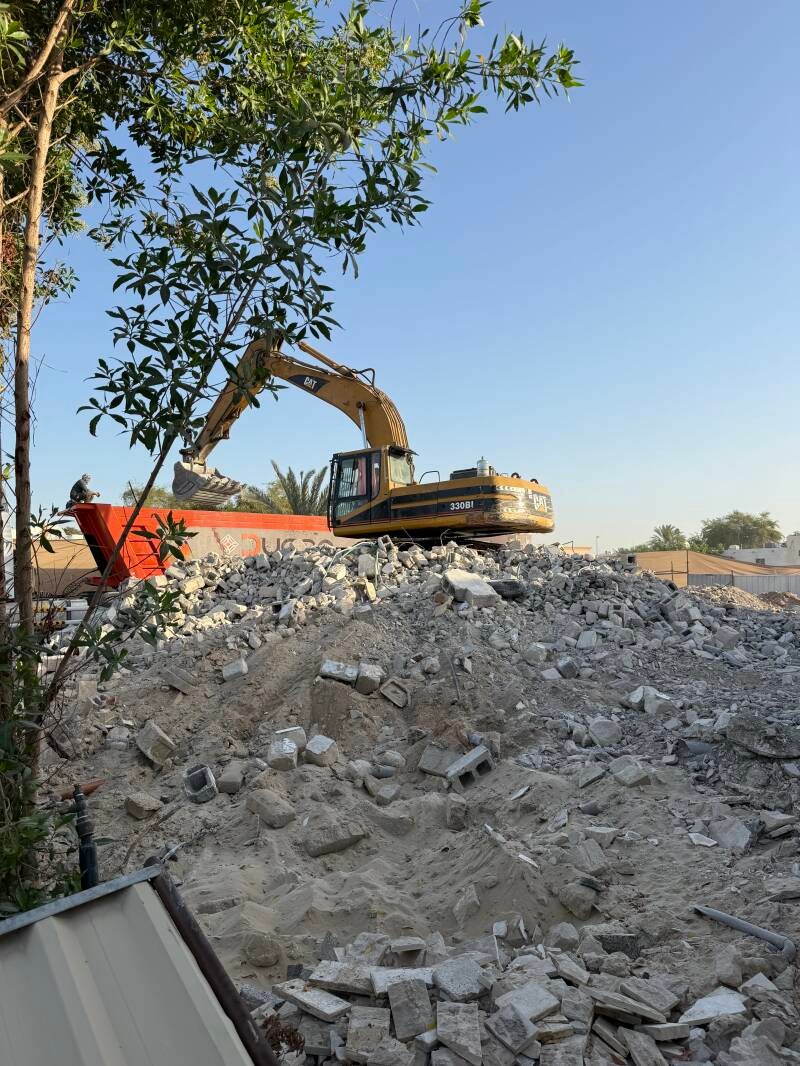
Low-vibration machinery first. Instead of large hydraulic breakers, we deploy smaller, low-vibration excavators and compact equipment when working inside the corridor, keeping ground vibration within RTA's limits.
Manual demolition where required. Where RTA prohibits heavy machinery entirely within a set distance of the rail structure, we switch to manual demolition for the foundations and elements nearest the line — breaking dense reinforced concrete by hand and with small tools rather than heavy breakers.
Controlled top-down sequence. We demolish in a controlled top-down sequence with continuous debris clearance, keeping the working zone stable and avoiding sudden load release near the rail corridor.
Dust suppression and protection. Water-spray dust suppression, protective screens and hoarding are used throughout to protect the rail structure and the public.
Vibration monitoring. Where RTA requires it, vibration monitoring sensors are installed near the rail structure and readings are tracked continuously during foundation demolition. If readings approach the RTA threshold, work stops immediately and the method is adjusted.
This matched-method approach is exactly what RTA wants to see in the method statement — and it is the difference between a NOC that is approved smoothly and one that is sent back for revision.
Conditions RTA May Impose After Approval
The Railway NOC may be approved without conditions — but on many projects near rail infrastructure, RTA imposes specific requirements. These are mandatory and must be followed exactly throughout demolition.
Restricted working hours. RTA may prohibit demolition activity during rail operating hours, or restrict vibration-generating equipment to nighttime windows when the Metro or Tram is not running. This directly affects your project schedule and must be factored into timeline planning from the start. For context on how demolition working hours are regulated across Dubai generally, see our guide on Dubai Municipality safety rules for demolition contractors.
Prohibited equipment types. Large hydraulic breakers and heavy excavators may be prohibited entirely within a defined distance from the rail structure. If this condition is imposed, your demolition method must change completely — from mechanical to manual. For a practical understanding of what this means for execution and cost, see our guide on manual vs mechanical demolition in Dubai.
Manual demolition requirement. If heavy machinery is prohibited near the rail structure, foundation demolition must be carried out manually or with small, low-vibration equipment only. Manual demolition of dense reinforced concrete foundations is significantly slower and more expensive than mechanical demolition. This must be factored into your cost planning before works begin. For a realistic picture of how demolition costs are built in Dubai, read our guide on villa demolition cost in Dubai.
Vibration monitoring. Where some mechanical work is permitted but must be controlled, RTA may require continuous vibration monitoring during foundation demolition. Sensors are installed near the rail structure, and readings must stay within RTA's defined limits. If readings exceed the threshold, work must stop immediately. For foundation demolition specifics, see our foundation demolition deep excavation guide.
Structural supervision. In some cases RTA requires a qualified structural engineer to be present on site during specific demolition phases to monitor works and certify compliance with the approved method.
What Happens if You Proceed Without the Railway NOC
First, in practical terms, you usually cannot even reach this stage — because the plot is blocked in the DM system and the demolition permit will not issue without the Railway NOC. But if works were ever started near the rail line without the required approval, RTA treats it as a serious violation.
Immediate stop-work order. RTA can halt demolition works on the spot. Once issued, the stop-work order cannot be lifted until the Railway NOC application is submitted, reviewed, and approved — which may take several weeks. The entire project stops.
Full contractor liability. If any damage occurs to rail infrastructure — columns, foundations, underground utilities, tram track, or the track structure itself — the demolition contractor is fully liable for the cost of repair. Repair works on metro columns, tram tracks, or underground rail structures are extremely expensive and technically complex.
Legal consequences. Beyond financial penalties, causing damage to public transport infrastructure can result in legal action. This is an unacceptable risk for any licensed demolition contractor in Dubai.
For context on how violations and stop-work orders work in the broader demolition permit system, see our guide on demolition permit rejection — common reasons and exact fixes. For a complete understanding of all RTA approvals required alongside the demolition permit, refer to our RTA road permit guide for demolition in Dubai.
How the Railway NOC Fits Into the Full Permit Sequence
When the Railway NOC is required, it must be built into the permit timeline from the very start — because until it is obtained, the plot is blocked in the DM system and nothing else can move.
Stage 1 — Early checks. Confirm whether your plot falls within the Metro or Tram safety corridor. Check the DM system for a railway condition on the plot. Raise the Railway NOC question before any permit applications are submitted. Review the building card and confirm whether the project is full or partial demolition. For full versus partial demolition classification rules, see our guide on full vs partial demolition in Dubai Municipality.
Stage 2 — Parallel NOC applications. DEWA disconnection NOC, Etisalat and du NOC, and RTA Drainage NOC are all submitted simultaneously. The Railway NOC application to RTA Rail Affairs is also prepared and submitted at this stage — in parallel, not after. Because the plot is blocked until the Railway NOC clears, it should be treated as the priority.
Stage 3 — RTA road permits. RTA demolition permit registration (48 hours), fencing permit, and access permit are applied for once the DM application is in progress.
Stage 4 — DM demolition permit submission. All NOCs including the Railway NOC are required as part of the authority approval package submitted to Dubai Municipality — and the DM system will not accept the application while the railway condition is unresolved. For plots registered through DDA, see our DDA demolition permit guide. The building card must be correct before the DM application can be processed — see our building card guide for demolition.
Stage 5 — Pre-work inspection. DM inspection team visits the site. No works can commence before inspection clearance.
Stage 6 — Demolition execution. All Railway NOC conditions imposed by RTA must be observed throughout — restricted hours, equipment limitations, vibration monitoring if required. All works must comply with the Dubai Municipality 2026 safety circular for demolition contractors.
Stage 7 — Completion certificate. On completion, site levelling and iron barrier installation are done, and the completion certificate application is submitted. For the full process, refer to our guide on the demolition completion certificate in Dubai Municipality.
How to Check if Your Plot Requires the Railway NOC
There is no publicly available map showing the exact boundary of RTA's rail safety corridor. The corridor dimensions depend on the specific structure type — elevated metro column, station structure, tram track, or underground rail utility — and your plot's distance and orientation from that structure.
The practical steps:
- Check whether the Metro Red Line, Green Line, or the Dubai Tram runs close to your plot — your affection plan and a map check will confirm proximity
- Check whether the plot already carries a railway condition/block in the Dubai Municipality system — this is the clearest signal the Railway NOC is mandatory
- Raise the Railway NOC question with your demolition contractor before any permit applications are started
- Your contractor can raise a preliminary inquiry with RTA Rail Affairs to confirm whether the NOC is triggered for your specific plot and demolition scope
- If triggered, the Railway NOC application must be prepared with proper structural drawings and submitted to RTA before the DM permit application can proceed
Do not assume that because a neighboring plot was demolished without issues, your project will follow the same path. Each project is assessed individually based on demolition scope, machinery type, excavation depth, and exact proximity to the rail structure.
Impact on Cost and Timeline
The Railway NOC adds real time and potentially significant cost to any demolition project where it is triggered.
Timeline: The Railway NOC review takes considerably longer than standard RTA permits. A standard RTA demolition permit registration takes 48 hours. The Railway NOC review may take 2 to 4 weeks or more depending on submission complexity and whether RTA requests revisions. And because the plot is blocked in the DM system until the NOC clears, this time sits at the very front of your project — if it is not planned for from the start, it delays everything.
Cost: If RTA prohibits heavy machinery, demolition cost increases substantially. Manual or small-equipment foundation demolition is more expensive and more time-consuming. Vibration monitoring equipment hire adds further cost. Nighttime-only working restrictions affect labour planning and productivity.
For a broader understanding of how permit complexity, site conditions, and authority requirements affect total demolition cost in Dubai, read our guide on villa demolition cost in Dubai — and our guide on the challenges commonly faced in demolition projects across Dubai.
Frequently Asked Questions
Does the Railway NOC apply to the Dubai Tram as well as the Metro? Yes. Both the Dubai Metro (Red and Green Lines) and the Dubai Tram (Marina, JBR, Al Sufouh, Media City) trigger the Railway NOC. RTA maintains a safety corridor around both, and plots near either will be blocked in the DM system until the NOC is obtained.
Why can't I submit my demolition permit application? If your plot is near the Metro or Tram, Dubai Municipality blocks it in the system with a railway condition. The application simply will not proceed until the Railway NOC from RTA is submitted and cleared. This is by design — it is not a technical error.
Is the Railway NOC only required in Al Quoz? No. Al Quoz is one area where it comes up frequently because it is an active demolition zone with the metro passing through. But the requirement applies anywhere in Dubai where demolition is planned near the Metro or Tram.
Does every plot near the rail line require a Railway NOC? Not necessarily. The requirement depends on your plot's exact proximity to the rail structure and your demolition scope. The clearest confirmation is whether the plot is blocked in the DM system — confirm with your contractor.
What if RTA prohibits heavy machinery on our project? Your contractor must revise the demolition method to manual or small-equipment demolition only. Cost and timeline must be reassessed before any mobilization date is committed.
Who prepares the drawings for the Railway NOC application? A qualified structural engineer familiar with rail proximity requirements must prepare the drawings. Generic demolition drawings are not sufficient for this application.
Which demolition contractor should I use for a project near the Metro or Tram? Use a DM-approved contractor with experience submitting Railway NOC applications. Not all contractors have done this. For guidance on what to look for when choosing a demolition contractor in Dubai, see our guide to selecting the right demolition company.
Contact Al Zelzal Demolition Works LLC
Al Zelzal Demolition Works LLC is a Dubai Municipality approved demolition contractor in Dubai with over 12 years of operational experience across all areas of the city. We handle the complete permit coordination process on behalf of property owners — including Metro and Tram Railway NOC applications — across Deira, Bur Dubai, Al Quoz, Al Barsha, Business Bay, Karama, Al Nahda, Dubai Marina, JBR, Al Sufouh, Jumeirah, Umm Al Sheif, Umm Suqeim, Khawaneej, Nad Al Hammar, Nad Al Shiba, and all other areas of Dubai.
Our demolition services cover villa demolition, building demolition, warehouse and industrial demolition, partial demolition, foundation removal, concrete cutting, debris removal, and full site clearance.
Call / WhatsApp: 056 780 0464
Free site inspection. Permit advice before you commit.
Add comment
Comments