Ask any experienced demolition contractor in Dubai what causes the most stop-work orders, legal disputes, and unexpected costs on a demolition project — and the answer is rarely the permit, the machinery, or the debris.
It is the neighboring building.
A cracked boundary wall next door. A neighbor claiming your excavator damaged their villa. A complaint to Dubai Municipality about vibration. One phone call from an unhappy neighbor can freeze an entire demolition site — even when your permit is fully valid.
The good news: almost every neighbor-related problem in demolition is preventable — if the right steps are taken before the first breaker touches concrete.
This guide explains exactly how professional contractors protect neighboring buildings during demolition in Dubai: the pre-demolition condition survey, vibration control, shoring and temporary support, safe excavation near plot boundaries, and what to do when a neighbor complaint is filed.
📞 +971 56 780 0464 🌐 www.zelzaldemolition.com 📍 Google Maps – Al Zelzal Demolition Works LLC
Why Neighboring Buildings Are the Biggest Risk on Dubai Demolition Sites
Dubai's plot layout makes neighbor protection more critical than in most cities:
- Zero-clearance construction — In older districts like Deira, Naif, Hor Al Anz, Muteena, and Al Murar, buildings and boundary walls are often physically attached to the neighboring structure. There is no gap at all.
- Tight villa plots — In areas like Jumeirah, Umm Suqeim, Al Wasl, and Al Barsha, villas frequently sit within 2–3 metres of the shared boundary wall.
- Shared (party) boundary walls — One wall serving two plots is extremely common. Demolishing on your side directly affects the neighbor's side.
- Older neighboring structures — Many adjacent villas were built 25–40 years ago. Existing cracks, settlement, and weak plaster are already present before your demolition starts — and without documentation, you may be blamed for damage that existed for years.
- Occupied neighbors — Unlike large cleared development sites, most villa demolitions in Dubai happen next to families who are living in their homes throughout the works.
Key point: Under Dubai Municipality regulations, the demolition contractor is responsible for any damage caused to neighboring properties during the works. Protection is not optional — it is a permit condition and a legal liability issue.
👉 Related: Demolition Challenges in Dubai (2026) – Problems & Solutions
Step 1: The Pre-Demolition Condition Survey (Dilapidation / Crack Survey)
This is the single most important neighbor-protection step on any demolition project — and the one most often skipped by inexperienced contractors.
What Is a Pre-Demolition Condition Survey?
A condition survey (also called a dilapidation survey or crack survey) is a documented inspection of the neighboring properties before demolition begins. It records the existing condition of:
- Boundary walls facing your plot
- External walls of the neighboring villa or building
- Existing cracks — location, length, width, and pattern
- Plaster condition, paint condition, tile condition
- Gates, fences, and any structures attached to the shared boundary
- Ground condition, interlock paving, and driveways near the boundary
How It Is Done Correctly
- Date-stamped photographs of every elevation facing your plot — wide shots plus close-ups of every existing crack
- Video walkthrough along the full shared boundary
- Crack measurement — width recorded with a crack gauge or ruler visible in the photo
- Crack monitoring gauges (tell-tales) installed across significant existing cracks so any movement during demolition can be measured objectively
- Written report listing all observations, signed and dated
- Neighbor acknowledgment — ideally, the neighbor signs the survey or receives a copy. Even a WhatsApp record of the shared photos with the date is valuable evidence.
Why It Protects Everyone
- It protects the property owner and contractor — if the neighbor later claims a crack was caused by your demolition, the survey proves whether the crack existed before works started.
- It protects the neighbor — if genuine new damage occurs, it is identified quickly, honestly, and repaired without dispute.
- It protects the project timeline — most vibration complaints to Dubai Municipality end quickly when the contractor produces a signed pre-demolition survey.
⚠️ Real-site rule: No condition survey = no defense. If a dispute reaches Dubai Municipality or Dubai Courts and there is no pre-demolition record, the assumption almost always goes against the demolition contractor.
What Happens If You Skip the Photos
If the neighboring plot has a villa or building, photographing all existing (old) crack areas before starting demolition — and keeping the records with you or submitting them to the authorities — is not a formality. Contractors who skip this step and then face a damage claim can expect:
- ❌ A heavy fine imposed by the authorities on the contractor
- ❌ The contractor being held liable to pay the full maintenance and repair cost of the neighbor's property — including cracks that existed for years before the demolition
- ❌ In serious cases, the contractor's account on the permit portal being blocked, which freezes not just this project but every other project the contractor has in Dubai
One set of dated photographs taken in 30 minutes protects against all three. This is the cheapest insurance in the entire demolition industry.
👉 Related: Pre-Demolition Checklist for Property Owners in Dubai (2026)
Step 2: Vibration Control During Demolition
Vibration is the most common source of neighbor complaints in Dubai demolition — and the most common cause of genuine damage to adjacent structures.
Where Vibration Comes From
- Hydraulic breakers (excavator-mounted) — the biggest source, especially during foundation and ground-slab breaking
- Excavator tracking and debris drops
- Loaded trucks moving on-site
- Compaction equipment during backfilling
How Professional Contractors Reduce Vibration Near Neighbors
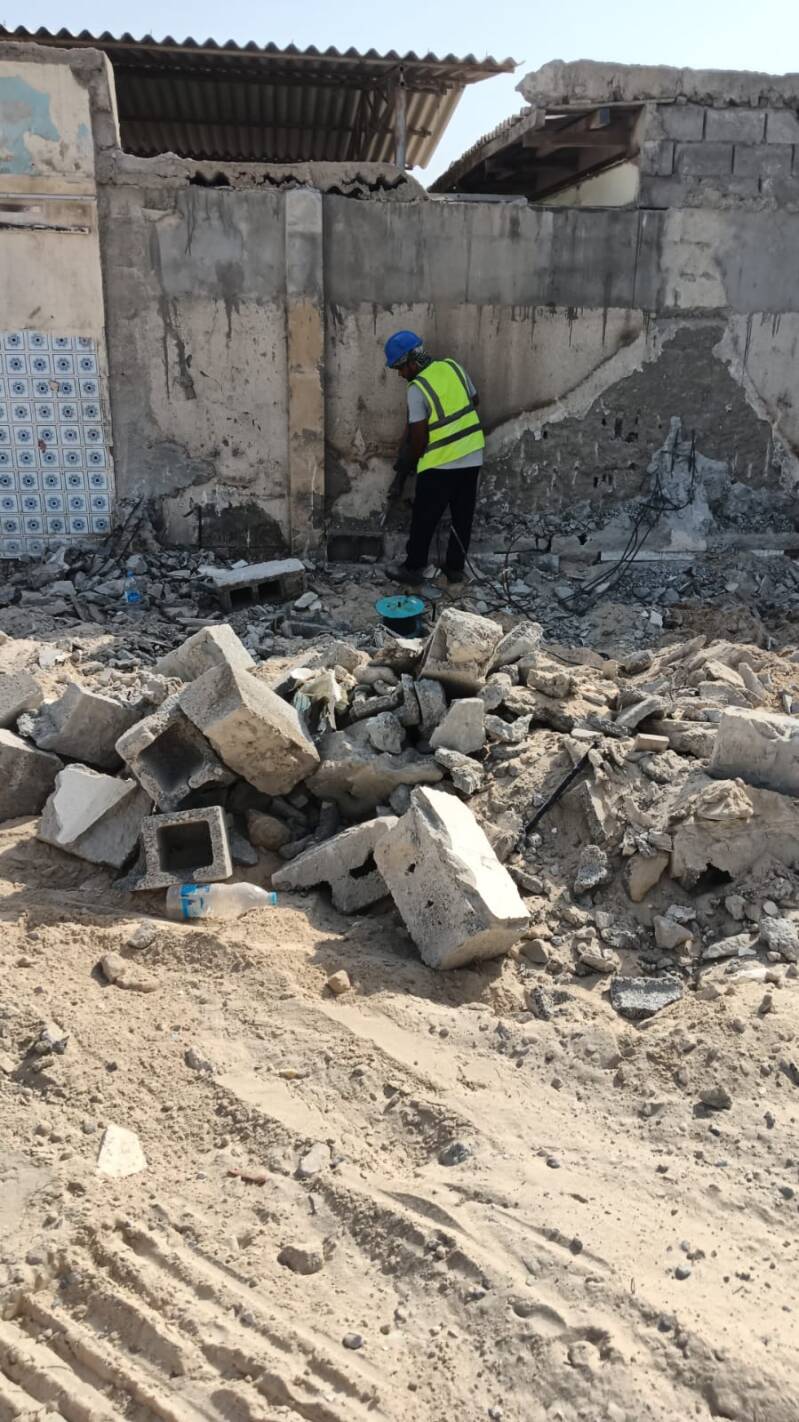
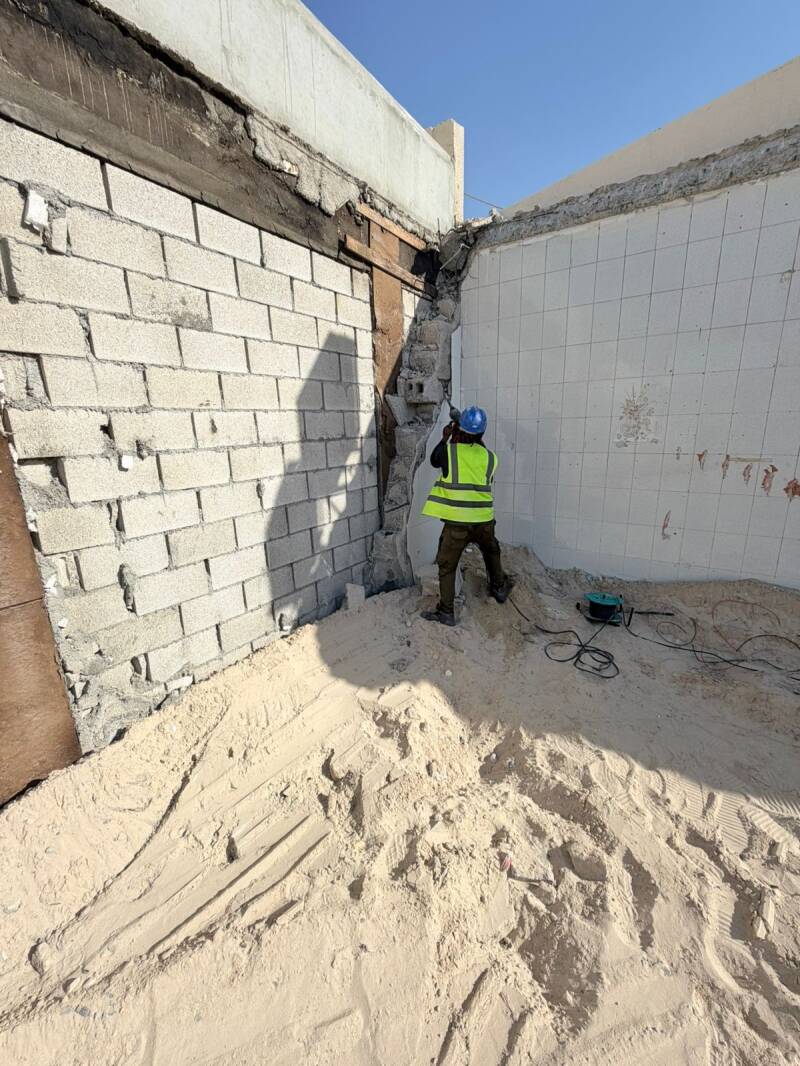
1. Manual demolition zone near the boundary — Any structure attached to, or within close range of, a neighboring wall is demolished manually first (jackhammers, cutting, hand tools). Mechanical equipment is only introduced after a safe separation — as a working rule, a minimum 3-metre clearance from the neighboring structure before heavy breakers operate.
👉 Related: Manual vs Mechanical Demolition in Dubai (2026 Guide)
2. Saw cutting instead of breaking at the interface — Where your structure meets the neighbor's wall (attached slabs, connected boundary walls), the connection is cut with a concrete saw or wire saw — never broken with impact tools. Cutting creates a clean separation joint so vibration from the rest of the demolition does not transfer into the neighbor's structure.
3. Right-sized equipment — Using a 30-ton excavator with a heavy breaker on a small villa next to an occupied neighbor is a mistake. Near boundaries, smaller breakers, mini-excavators, and crushers/pulverizers (which crush concrete instead of hammering it) dramatically reduce transmitted vibration.
4. Controlled sequence — top-down, away from the neighbor — Demolition proceeds from the point closest to the neighbor outward, so heavy breaking happens progressively further from the shared boundary.
5. Drop-height control — Debris is lowered or dropped onto a cushion of previously broken material or sand, not onto bare ground slab, which transmits shock into the soil.
6. Vibration monitoring on sensitive sites — Next to old, cracked, or occupied structures, a vibration monitor (seismograph) placed at the neighbor's boundary records peak particle velocity (PPV) throughout the works. If readings approach the safe limit, the method is adjusted immediately. Monitoring records are also powerful evidence if a complaint is filed.
7. Working hours discipline — Heavy breaking is kept within approved working hours (typically 7:00 AM – 7:00 PM). Night works require a separate permit.
👉 Related: Dubai Police Night Works Permit for Demolition (2026 Guide)
The Old-Villa Rule: Bucket Only — No Jackhammer
This is one of the most important real-site rules in Dubai demolition, and it separates experienced contractors from everyone else:
If the neighboring villa is very old, never use an excavator-mounted jackhammer (breaker) in that area — at all.
Old villas in Dubai — with weak plaster, shallow footings, and decades of settlement — cannot handle the vibration from foundation breaking. When a jackhammer works on a foundation, the impact travels directly through the ground into the neighboring villa's structure. In an old villa, that vibration can cause:
- Ceiling sections or ceiling plaster falling down inside the neighbor's rooms
- Wall tiles dropping off in bathrooms and kitchens
- Cracked gypsum works, loose fixtures, and falling decorative elements
- New structural cracks opening, and old cracks widening
These failures happen inside the neighbor's home — sometimes while the family is in the room. This is exactly why the bucket method is used instead of the breaker near old villas. So on the boundary side facing an old villa:
- ❌ No hydraulic breaker / jackhammer — not on the structure, not on the slab, not on the foundation
- ❌ Do not break or demolish the foundation in place in that zone
- ✅ Use the excavator bucket only — far less vibration than any impact tool
- ✅ Excavate around the foundation with the bucket, free the footing from the soil
- ✅ Lift the foundation pieces out whole and load them directly onto the truck — no breaking on the ground, no hammering into smaller pieces near the old villa
- ✅ If pieces must be reduced in size, move them to the far side of the plot — away from the old villa — before any breaking
Yes, this method is slower and needs more truck trips, because you are hauling large foundation pieces instead of crushed concrete. But it is the only safe way to remove foundations beside a fragile old structure — and it is far cheaper than paying for a cracked neighboring villa.
Step 3: Shoring and Temporary Support — When the Neighbor's Structure Depends on Yours
In attached and zero-clearance construction, the neighboring wall may be partially supported by the structure you are about to demolish. Removing your building without temporary support can cause the neighbor's wall to crack, lean, or collapse.
When Shoring Is Required
- Party walls — a shared wall on the property line used by both plots
- Attached buildings — your external wall and the neighbor's wall are in direct contact (common in Deira, Naif, Hor Al Anz)
- Neighbor's boundary wall built against your structure — very common in older villa areas
- Deep foundation removal near a neighbor's footing — where excavation goes below the level of the neighbor's foundation
Common Temporary Support Methods
- Raking shores — inclined steel or timber props supporting the neighbor's wall from the ground during and after demolition of the attached structure
- Vertical props / flying shores — supporting connected slabs or walls until separation is complete
- Needle beams — where a section of shared wall must be temporarily carried while the supporting structure below is removed
- Sheet piles or secant piles — for deep excavation and foundation removal close to the neighbor's footing, preventing soil movement under the neighbor's foundation
⚠️ Critical rule: Shoring design near a neighboring structure is an engineering decision, not a site improvisation. It must be included in the approved Method Statement, and on sensitive sites it should be designed or reviewed by a qualified structural engineer.
👉 Related: Villa Demolition Method Statement & Risk Assessment in Dubai (2026)
Step 4: Safe Excavation and Foundation Removal Near Plot Boundaries
Neighbor damage does not only happen above ground. Some of the worst cases occur during foundation demolition and excavation — after the building is already down and the owner thinks the risk is over.
The Undermining Risk
When you excavate to remove footings near the boundary, and the excavation goes deeper than the neighbor's foundation level, the soil supporting the neighbor's footing can slide into your excavation. The result: settlement cracks in the neighbor's villa, sinking boundary walls, and in extreme cases partial collapse.
How It Is Prevented
- Confirm the neighbor's foundation depth before excavating near the boundary (older villas often have shallow footings — sometimes less than 1 metre)
- Maintain a safe offset — do not excavate below a line projecting down and away from the neighbor's footing (the "zone of influence")
- Benching / stepped excavation near the boundary instead of vertical cuts
- Sheet piling or shoring where deep removal directly beside the boundary cannot be avoided
- Immediate backfilling and compaction of boundary-side excavations — never leave a deep open trench along a neighbor's wall overnight
- Dewatering control — uncontrolled groundwater pumping near a boundary can pull fine soil from under the neighbor's foundation
- Old neighboring villa? Bucket only — as explained above: no breaker in that zone. Excavate the footing free with the bucket, lift the pieces out whole, and load them directly to the truck. Never hammer foundations in the ground next to an old villa.
👉 Related: Foundation Demolition in Dubai – Deep Excavation Guide (2026)
Step 5: Dust, Debris, and Falling-Material Protection
Physical protection of the neighbor's side is a Dubai Municipality permit condition — and the most visible sign of a professional site.
- Full-height site hoarding / fencing installed before demolition begins, on all sides including the shared boundary
- Debris netting or protective screens on the boundary side to stop flying fragments
- Protection of the neighbor's boundary wall — plywood sheets or rubber matting against the neighbor's wall where machinery works close to it
- No debris loading against the neighbor's wall — broken concrete must never be stockpiled leaning on a shared or neighboring boundary wall; the lateral pressure cracks and pushes walls over
- Continuous water spraying for dust suppression — dust complaints from neighbors are treated seriously by Dubai Municipality inspectors
- Covered trucks for debris removal, and street cleaning at the gate so the neighbor's frontage stays clean
👉 Related: Dubai Municipality Circular 2026 for Demolition Contractors – Safety Rules Across Dubai
Communicating With Neighbors — The Step That Prevents 90% of Complaints
Most neighbor complaints in Dubai are not really about cracks or dust. They are about surprise. A neighbor who wakes up to an excavator next to their bedroom wall with no warning will complain — even if the site is fully compliant.
A professional approach:
- Inform neighbors before mobilization — a short visit or letter: what is being demolished, start date, expected duration, working hours, and the contractor's contact number
- Give a direct site contact — a supervisor's phone number the neighbor can call, instead of calling Dubai Municipality first
- Share the condition survey — showing the neighbor that their wall was photographed and documented builds trust immediately
- Warn before the loudest phases — a message the day before foundation breaking starts goes a long way
- Respond fast to any concern — inspect the same day, document, and fix genuine issues without argument
Two Rules That Are Never Broken on a Professional Site
1. Never, ever fight or argue with the neighboring plot owner. No matter how unreasonable a complaint feels, the site team stays calm, listens, documents, and resolves. One argument at the gate can turn a small concern into a formal complaint, an inspection, and a stopped site. The neighbor will still be living there long after your project is finished — respect wins every time.
2. Always respect the neighbor's sleeping time. No early-morning engine starts, no debris drops, no reversing alarms echoing at dawn, and absolutely no heavy breaking outside approved hours. Rest-hour discipline is the single biggest factor in whether neighbors tolerate a demolition next door or fight it from day one.
For shared (party) walls, communication is not just courtesy — the neighbor has rights in the wall, and written acknowledgment should be obtained before demolition of any shared structure.
👉 Related: Boundary Wall Demolition in Dubai – Permit Rules, Process & Neighbor Issues (2026)
What Happens When a Neighbor Files a Complaint?
Even on well-run sites, complaints happen. Here is the realistic sequence in Dubai:
- Complaint submitted — usually to Dubai Municipality (via the DM app or call center), sometimes to Dubai Police for noise/night work
- Inspector visit — a DM inspector visits the site, checks the permit, hoarding, working hours, dust control, and the approved Method Statement
- Possible outcomes: ✅ Site compliant → complaint closed, works continue. ⚠️ Minor issues → corrective instructions (improve dust control, adjust hours, add protection). ❌ Serious violation or suspected structural damage → stop-work order until the issue is resolved
- If damage is claimed — the pre-demolition condition survey becomes the deciding document. New damage is assessed, and repair is handled through the contractor's third-party liability insurance or direct repair agreement.
How to Keep a Complaint From Stopping Your Project
- Valid permit and approved Method Statement available on site at all times
- Signed pre-demolition condition survey with photos
- Vibration monitoring records (on sensitive sites)
- Evidence of neighbor notification
- Immediate, cooperative response to the inspector — sites that argue get stopped; sites that show documents keep working
Who Is Legally Responsible for Neighbor Damage?
- The demolition contractor carries primary responsibility for damage caused by demolition operations — this is why working with a Dubai Municipality–approved contractor with valid third-party liability insurance is essential
- The property owner can also be drawn into disputes, especially if an unlicensed or uninsured contractor was appointed to save cost
- Insurance — before signing any demolition contract, confirm the contractor holds third-party liability coverage adequate for the site conditions (attached structures and occupied neighbors justify higher coverage)
⚠️ The cheapest quotation on a tight plot next to an occupied villa is often the most expensive decision an owner ever makes. One cracked neighboring wall can cost more than the entire demolition contract.
👉 Related: Top Demolition Companies in Dubai (2026) – How to Choose the Right Contractor
Neighbor-Protection Checklist for Property Owners
Before demolition starts on your plot, confirm your contractor has completed:
- ✅ Pre-demolition condition survey of all neighboring structures (photos + video + written report)
- ✅ Crack monitoring gauges on significant existing cracks
- ✅ Neighbor notification with start date, duration, and site contact number
- ✅ Written acknowledgment for any shared (party) wall demolition
- ✅ Method Statement covering manual demolition zone, saw cutting at interfaces, and shoring where required
- ✅ Full-height hoarding and boundary-side protection installed before works
- ✅ Dust suppression system ready (water supply confirmed on site)
- ✅ Third-party liability insurance copy received
- ✅ Vibration monitoring arranged (if neighboring structure is old, cracked, or occupied at zero clearance)
- ✅ Foundation removal plan reviewed for excavation near the boundary
- ✅ Old neighboring villa? Confirmed in writing: no jackhammer/breaker in that zone — bucket-only excavation, foundation pieces lifted out whole and loaded directly
FAQ – Protecting Neighboring Buildings During Demolition in Dubai
Do I legally need a condition survey of my neighbor's villa before demolition?
Treat it as mandatory. If damage is claimed and there are no dated photos of the old cracks, the contractor faces a heavy fine, can be made to pay the full repair and maintenance cost of the neighbor's property, and in serious cases the contractor's permit portal account is blocked. Photos taken before works start — kept on record or shared with the authorities — are the only protection.
My neighbor's wall already has cracks. Should I still demolish?
Yes — but document every existing crack in detail first, install monitoring gauges, and use a low-vibration method near that boundary. Old cracks are exactly why the survey exists.
The villa next door is very old. How should the demolition be done?
No excavator-mounted jackhammer anywhere near that boundary — the vibration from foundation breaking can bring down ceiling plaster and wall tiles inside the old villa. Do not break the foundation in the ground in that zone. The safe method: excavate around the footing using the bucket only (much less vibration), lift the foundation pieces out whole, and load them directly onto the truck. Any size reduction happens on the far side of the plot, away from the old villa.
Can my neighbor stop my demolition?
Not if your permit is valid and your site is compliant. A complaint triggers an inspection, not an automatic stop. Sites are stopped for violations or genuine safety risks — not simply because a neighbor objects.
Who pays if the demolition cracks my neighbor's wall?
The demolition contractor, through direct repair or third-party liability insurance. This is why owners should never appoint an unlicensed or uninsured contractor.
Is vibration monitoring mandatory in Dubai?
It is not required on every site, but on zero-clearance and sensitive sites it is strongly recommended — and inspectors view monitored sites far more favorably when complaints arise.
What is the safe distance for mechanical demolition from a neighboring structure?
As a practical working rule used on Dubai sites: attached or near-boundary sections are demolished manually first, and heavy mechanical breaking begins only after a minimum 3-metre separation is achieved. The exact approach must be defined in the approved Method Statement for each site.
Demolishing Next to an Occupied Villa? Do It the Professional Way
Al Zelzal Demolition Works LLC has completed demolition projects on some of the tightest plots in Dubai — attached buildings in Deira, zero-clearance boundary walls in Hor Al Anz, and villas standing 2 metres from occupied neighbors in Jumeirah and Al Wasl — without neighbor disputes, because protection is engineered into every project from day one:
- Documented pre-demolition condition surveys on every boundary
- Manual demolition zones and saw-cut separation at every interface
- Engineered shoring where neighboring structures need support
- Vibration-controlled methods and monitoring on sensitive sites
- Full Dubai Municipality compliance — permit, Method Statement, hoarding, dust control, and Completion Certificate
📞 Call / WhatsApp: +971 56 780 0464
🌐 www.zelzaldemolition.com
📍 Google Maps – Al Zelzal Demolition Works LLC
Al Zelzal Demolition Works LLC — Dubai Municipality–approved demolition contractor for villa demolition, building demolition, boundary wall demolition, and foundation removal across Dubai.
Add comment
Comments