Al Quoz is not a typical demolition location.
It is Dubai's largest and most active industrial zone — a dense mix of warehouses, factories, car showrooms, workshops, labour camps, and storage facilities spread across four sub-areas, all within close proximity to the Dubai Metro Red Line, major arterial roads, and active commercial neighbours.
Demolition here follows the same Dubai Municipality framework as anywhere else in Dubai — but with additional layers that don't apply in residential areas: Metro NOC requirements, fire safety conditions for industrial structures, scrap recovery considerations, and stricter method statement expectations because of the working environment around the site.
This guide covers everything a property owner or business operator needs to understand before starting demolition in Al Quoz — including the DM permit process, which NOCs apply, what makes industrial demolition different, and what to look for in a contractor.
📞 +971 56 780 0464 🌐 www.zelzaldemolition.com 📍 Google Maps – Al Zelzal Demolition Works LLC
What Makes Al Quoz Different from Residential Demolition Zones?
Most Dubai demolition blogs focus on villa demolition in Jumeirah, Umm Al Sheif, or Al Wasl. Al Quoz operates under a completely different set of conditions.
Key differences in Al Quoz:
Structure type — Warehouses and industrial buildings are predominantly steel-framed with metal cladding, concrete floors, and mezzanine levels. Demolition methodology is entirely different from a concrete block villa. Steel cutting, structural dismantling, and careful sequence planning are required.
Plot size — Industrial plots in Al Quoz are significantly larger than residential plots. Larger footprints mean more debris volume, longer timelines, and heavier equipment requirements.
Adjacent activity — Unlike a vacant residential street, demolition in Al Quoz happens next to active businesses — warehouses still operating, vehicles moving, workers present. Dust, noise, and falling debris management is more complex.
Metro Red Line proximity — Parts of Al Quoz 1 and Al Quoz 3 sit directly adjacent to the Dubai Metro Red Line. Any demolition near the metro corridor requires a separate Metro NOC from the RTA — and in some cases, heavy machinery is prohibited entirely.
Scrap value — Industrial structures contain significantly more recoverable steel and aluminium than residential buildings. A properly managed Al Quoz warehouse demolition can return AED 15,000 to AED 30,000+ to the client through approved scrap recycling — sometimes reducing the net demolition cost to near zero.
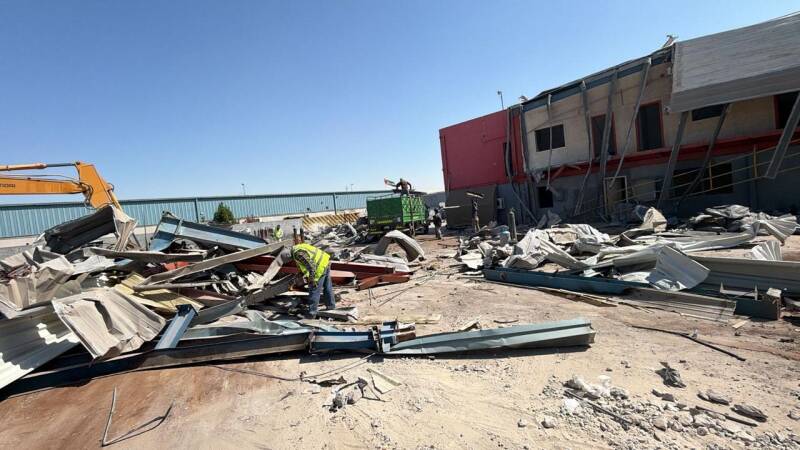
✅ Real project (Feb 2026): Al Zelzal completed a warehouse demolition in Al Quoz — 58 tons of steel recovered, AED 25,000 returned to client after Dubai Municipality–approved recycling.
👉 Related: Recovering Value: How Salvage & Recycling Can Reduce Demolition Costs in Dubai (2026)
Al Quoz Sub-Areas: What You Need to Know
Al Quoz is divided into four sub-areas with different characters and plot types.
Al Quoz 1 — Mixed industrial and commercial. Includes plots adjacent to Sheikh Zayed Road. High-visibility area. Road-adjacent demolition here often requires an RTA NOC. Metro Red Line runs through or adjacent to parts of this area.
Al Quoz 2 — Primarily industrial. Warehouses, factories, and workshops. Less road-adjacent exposure but still requires full DM permit process.
Al Quoz 3 — Dense industrial cluster. High concentration of warehouses and storage. Some plots are close to metro infrastructure. Method statements must address confined site conditions.
Al Quoz 4 — Mixed-use transitioning area. Includes some residential and retail alongside industrial. Demolition scope and permit requirements depend entirely on what structure type is registered on the building card.
⚠️ Always confirm your plot's sub-area and structure type before beginning the permit process. What applies in Al Quoz 1 may not apply in Al Quoz 4.
Dubai Municipality Demolition Permit for Al Quoz – The Process
Industrial demolition in Al Quoz follows the same Dubai Municipality permit framework as all demolition in Dubai — but with additional documentation requirements because of the structure type and zone.
Step-by-step process:
1. Confirm demolition scope Full demolition (entire structure including foundations) or partial demolition (selective removal of elements). This determines how the permit is classified.
👉 Related: Full vs Partial Demolition in Dubai Municipality (2026)
2. Review the building card All structures registered on the DM building card must be accounted for in the demolition scope. In Al Quoz, this typically includes the warehouse or factory structure, boundary walls, gates, and ancillary buildings (guard rooms, office annexes, substation rooms).
👉 Related: Building Card in Dubai Municipality Portal – Demolition Guide
3. Collect all required NOCs Before submitting the DM permit, you must have clearance from:
- DEWA (electricity and water disconnection)
- Etisalat / Du (telecom disconnection)
- RTA (if plot borders a public road or metro corridor)
- Dubai Metro NOC (if site is within the metro safety zone — see section below)
- Dubai Civil Defence (for certain industrial structures — see section below)
4. Prepare method statement and risk assessment For industrial demolition in Al Quoz, a detailed method statement is mandatory. It must cover: demolition sequence, equipment list, dust and noise control, debris removal plan, and safety measures for adjacent active businesses.
👉 Related: Warehouse Demolition Method Statement Dubai – Full Foundation Demolition
5. Submit DM permit application Submitted by a DM-approved demolition contractor through the Dubai Municipality portal. All NOC clearances, method statement, and drawings are attached.
6. DM review and permit approval Dubai Municipality reviews the application. For industrial structures, the review may take longer than residential permits due to the complexity of the structure and supporting documents.
7. Execute demolition Work begins only after the permit is issued and displayed on site. All work must follow the approved method statement.
8. Final inspection and completion certificate DM inspects the cleared site — including foundation removal — before issuing the demolition completion certificate.
👉 Related: Demolition Completion Certificate in Dubai Municipality (2026)
Metro NOC for Demolition in Al Quoz – When It's Required
This is the most Al Quoz-specific permit requirement and one of the most commonly misunderstood.
The Dubai Metro Red Line passes through Al Quoz. RTA enforces a safety exclusion zone around metro infrastructure — tracks, columns, stations, and underground utilities related to the metro system.
Metro NOC is required when:
- Your plot is within the RTA-defined metro safety corridor
- Demolition involves excavation, heavy machinery, or vibration-generating equipment near the metro structure
- Foundation demolition reaches depths that could affect metro infrastructure
What the Metro NOC process involves:
- Application submitted to RTA (Metro Affairs department)
- Structural drawings and method statement must be submitted showing the demolition scope relative to metro infrastructure
- RTA assesses the safety impact
- Approval may come with conditions — restricted working hours, prohibited equipment types, or mandatory monitoring during excavation
If your building is very close to the metro:
- Heavy machinery (large excavators, hydraulic breakers) may be prohibited entirely
- Demolition must be carried out manually or with small equipment only
- Vibration monitoring may be required during foundation demolition
⚠️ Proceeding with heavy demolition near metro infrastructure without the Metro NOC is a serious violation. RTA can issue stop-work orders immediately and hold the contractor liable for any damage to metro infrastructure.
Fire Safety Requirements for Industrial Demolition in Al Quoz
Al Quoz is classified as a high-risk demolition zone by Dubai Civil Defence for several reasons:
- Industrial warehouses frequently contain stored goods, chemicals, flammable materials, and gas cylinders — even after the business has vacated
- Steel cutting during demolition produces sparks and heat that can ignite residual materials
- Adjacent active businesses increase the risk of fire spreading
What this means for your demolition project:
Pre-demolition inspection — The site must be fully cleared of all stored goods, chemicals, and flammable materials before demolition begins. Dubai Civil Defence may inspect the site before approving demolition in certain cases.
Fire safety equipment on site — Fire extinguishers must be present and accessible throughout the demolition. For steel cutting operations, a fire watcher is required.
Hot work permit — Any cutting, grinding, or welding on site may require a hot work permit issued by Dubai Civil Defence.
DCD NOC — For larger industrial structures or where hazardous materials are known to be present, a formal Dubai Civil Defence NOC may be required before the DM demolition permit is approved.
Demolition Methodology for Al Quoz Warehouses
Industrial warehouse demolition in Al Quoz typically follows a different sequence from villa demolition.
Typical Al Quoz warehouse demolition sequence:
Stage 1 – Pre-demolition preparation Remove all stored goods, racking systems, equipment, and internal fit-out. Disconnect all utilities. Obtain all NOC clearances.
Stage 2 – Roof and cladding removal Steel roof sheets and wall cladding panels are removed first — carefully, to preserve scrap value. This is the highest-yield stage for scrap recovery.
Stage 3 – Steel structure dismantling Steel portal frames, columns, purlins, and beams are cut down in sequence. A methodical top-down approach is used to prevent uncontrolled collapse. All steel is segregated for recycling.
Stage 4 – Concrete floor and internal slabs Concrete floor slabs, mezzanine decks, and internal walls are broken up using hydraulic breakers and excavators.
Stage 5 – Foundation demolition Below-ground footings, ground beams, and pile caps are excavated and removed. In Al Quoz, foundations are typically 1.5m–3m deep.
Stage 6 – Debris removal and site clearance All debris is loaded and transported to approved DM disposal sites. The cleared plot is inspected by DM for the completion certificate.
👉 Related: Manual vs Mechanical Demolition in Dubai (2026 Guide)
👉 Related: Foundation Demolition in Dubai – Deep Excavation Guide (2026)
Scrap Recovery in Al Quoz – How It Reduces Your Net Cost
This is one of the most significant financial considerations specific to Al Quoz demolition.
Steel and aluminium prices in Dubai scrap markets fluctuate, but the volumes recovered from a single Al Quoz warehouse are substantially larger than anything recovered from a residential villa.
Typical recovery from an Al Quoz warehouse demolition:
- Steel portal frames and columns — High value. A standard warehouse can yield 30–80+ tons of structural steel.
- Aluminum cladding and roofing sheets — High value per kg. Even partially damaged sheets have strong scrap value.
- Internal racking and mezzanine steel — If left behind by the previous tenant, adds to the recoverable volume.
- Copper wiring and electrical components — Recovered from electrical panels and cable runs.
How recovered value is applied:
A reputable contractor will weigh all recovered materials at a DM-approved recycling facility, document the weights and values, and deduct the recovered amount from the total demolition cost — or return it directly to the client.
⚠️ Always confirm in writing how scrap recovery is handled in the demolition contract. Some contractors retain scrap value without disclosure. This should be agreed and documented before work begins.
👉 Related: Recovering Value: Salvage & Recycling to Reduce Demolition Costs in Dubai (2026)
What to Look for in an Al Quoz Demolition Contractor
Not every Dubai demolition contractor is equipped for industrial work in Al Quoz. The combination of large structures, Metro NOC requirements, fire safety conditions, and scrap management means the contractor selection matters significantly.
Minimum requirements:
- Dubai Municipality approved — The contractor must be registered with DM under the correct demolition category. Verify this through the DM contractor portal.
- Experience with industrial and warehouse demolition — Villa demolition contractors are not automatically equipped for steel structure dismantling. Ask for completed Al Quoz project references.
- Metro NOC capability — The contractor must understand the RTA Metro NOC process and have submitted it before. Not all contractors have done this.
- Scrap management transparency — The contractor must have a clear, documented process for weighing, selling, and accounting for recovered scrap materials.
- Proper equipment — Hydraulic excavators, steel cutting equipment, debris trucks. Confirm equipment is available and appropriate for the structure size.
- Method statement quality — Request to see a sample method statement. For industrial demolition in Al Quoz, a vague one-page document is not adequate.
👉 Related: Top Demolition Companies in Dubai (2026) – How to Choose the Right Contractor
Real Site Issues in Al Quoz – What We See in 2026
Based on active projects handled by Al Zelzal Demolition Works LLC in Al Quoz, these are the most common problems:
1. Metro NOC not identified until permit rejection
Owner and contractor proceed through DEWA, Etisalat/Du, and DM application without checking Metro NOC requirement. DM system flags it. Application rejected. Metro NOC process begins from scratch — adding 2–4 weeks.
Solution: Check proximity to metro infrastructure at the very first stage of planning, before any application is submitted.
2. Stored goods not removed before demolition start
Business tenant has vacated but left behind chemicals, gas cylinders, paint, or other flammable materials. DCD inspection flags the site. Demolition cannot begin until full clearance is confirmed.
Solution: Conduct a pre-demolition inspection with the contractor before any NOC applications are submitted. Identify and remove all hazardous materials in advance.
3. Scrap value not accounted for in initial quote
Owner receives a demolition quote, accepts it, and only later discovers the contractor kept AED 20,000+ in recovered steel without disclosure. Dispute arises after the job is done.
Solution: Insist on a written clause in the demolition contract specifying how scrap is valued, who receives it, and how it is documented.
4. Foundation depth underestimated
Industrial buildings in Al Quoz often have deeper and heavier foundations than expected — especially older warehouses built in the 1990s–2000s. Foundation removal takes longer and costs more than the initial estimate.
Solution: Request a site investigation or ground-level assessment from the contractor before finalising the quote. Experienced contractors will flag potential foundation issues before work begins.
5. Adjacent business disruption complaints
Demolition generates noise, dust, and vehicle movements that affect neighbouring warehouses. If not managed properly, complaints are made to DM and the contractor receives a warning or site pause.
Solution: Dust suppression, site hoarding, controlled working hours, and advance communication with adjacent businesses are all part of responsible industrial demolition practice.
Al Quoz Demolition Cost – What to Expect
Industrial demolition pricing in Al Quoz depends on structure size, material type, foundation depth, and scrap recovery value.
| Factor | Impact on Cost |
|---|---|
| Steel-framed warehouse | Lower gross cost — high scrap recovery offsets |
| Concrete industrial building | Higher gross cost — less recoverable value |
| Foundation depth | Deeper foundations increase cost significantly |
| Plot size | Larger plots = more debris volume = higher removal cost |
| Metro NOC requirement | Adds NOC cost and potentially restricts equipment (manual work = higher labour cost) |
| Hazardous material removal | Additional cost if present |
For a standard Al Quoz warehouse with steel structure and moderate foundations, the net cost after scrap recovery can be substantially lower than the gross price — in some cases approaching zero.
Always request an itemised quote that separates gross demolition cost from estimated scrap recovery credit.
Summary
- Al Quoz demolition follows the standard DM permit process but with additional requirements specific to industrial zones
- Metro NOC from RTA is required for plots within the metro safety corridor — check this before any application
- Dubai Civil Defence fire safety requirements apply to industrial structures — hot work permits and pre-demolition hazardous material clearance are mandatory
- Industrial warehouse demolition produces significantly higher scrap recovery value than residential demolition — this must be contractually documented
- Method statements for Al Quoz must be detailed and specific — not generic documents
- Contractor selection matters: verify DM approval, industrial experience, Metro NOC capability, and scrap transparency
Contact Al Zelzal Demolition Works LLC
Al Zelzal Demolition Works LLC is a Dubai Municipality approved demolition contractor with active project experience across Al Quoz 1, 2, 3, and 4 — including Metro NOC submissions, industrial dismantling, full foundation removal, and DM-approved scrap recycling.
📞 +971 56 780 0464 🌐 www.zelzaldemolition.com 📍 Google Maps – Al Zelzal Demolition Works LLC
Add comment
Comments