Many people are posting incorrect and misleading information about the Dubai Municipality demolition exam without real understanding or site experience. This post is written to clarify what actually matters, based on Dubai Municipality engineering practice — not assumptions.
The demolition exam itself is straightforward. The focus should not be on fear of the exam, but on understanding demolition engineering in Dubai.
Demolition – Dubai Municipality (G+1 Level)
In Dubai, demolition works are a regulated engineering activity and require an approved demolition contractor and a Dubai Municipality accredited engineer.
Governing Authority
- Dubai Municipality
- Engineer qualification is managed through the Dubai Engineering Qualification System (DEQ)
Purpose of G+1 Accreditation
- To ensure engineers are competent and knowledgeable in Dubai construction regulations, codes, and technical standards
- Required when a company wants to register an engineer for demolition activities up to G+1 buildings (ground + 1 floor)
- Al Zelzal Demolition Works LLC is one of the DM registered demolition contractors in Dubai
What "Demolition" Covers (G+1 Category)
At G+1 level, demolition typically includes:
- Warehouse demolition
- Low-rise building demolition (Ground + 1 floor)
- Industrial sheds and structures
- Partial demolition
- Concrete breaking and site clearance
Note: High-rise or complex demolitions require higher classification (G+4 or special approval).
Demolition Engineer – G+1 Accreditation
To work legally on demolition projects, a company must appoint a DM-approved engineer.
Eligibility Requirements (G+1 Level)
Educational:
- Bachelor's degree in Civil or Architectural Engineering is typically required
Experience:
- At least 3 years of relevant engineering experience for bachelor's degree holders
- For diploma holders, a minimum of 5 years' experience may be required — diploma holders may receive a technician-level accreditation with certain limitations
Tips Before Taking the G+1 Exam
- Become a member of the Society of Engineers (SOE) UAE — often required. Portal: https://www.soeuae.ae/en/Login.aspx
- Prepare by reviewing the Dubai Building Code and technical regulations
- Ensure all education and experience certificates are attested
How to Apply for the G+1 Exam
- Create an account on the Dubai Engineering Qualification (DEQ) portal on the Dubai Municipality website
- Upload your qualification documents — degree, experience certificates, passport, Emirates ID, visa, Society of Engineers membership
- Choose the G+1 Demolition exam and schedule a date
- Pay the required exam fee of AED 420
- Sit for the exam at an approved centre
DEQ portal: https://deqsmart.dm.gov.ae/EisPortal/faces/login/login.jsf
Demolition Exam – Basic Facts
- The demolition exam contains 20 questions
- You must answer 15 questions correctly to pass
- Exam registration is done through the Dubai Engineering Qualification System (DEQ)
- Exam schedule is available after payment
No shortcuts, no tricks.
Why This Accreditation Is Important
Without a G+1 accredited demolition engineer:
- Demolition permits will be rejected or DEQ suspension applied
- Projects may be stopped by inspectors
- Company classification cannot be upgraded
- Penalties or black points may apply
With accreditation:
- Legal demolition approvals proceed smoothly
- Municipality inspections pass without issue
- Company credibility and classification improve
After Passing the Exam
- You will receive a professional qualification certificate that can be linked to your company's licence for the G+1 category with Dubai Municipality
- You can then be registered and added as an approved engineer for your company's engineering activity in the Municipality DEQ system
Demolition – Definition (Very Important)
Demolition is the controlled and systematic dismantling of a building or structure, carried out in a planned sequence to ensure structural stability, safety of workers, public protection, and protection of adjacent properties — in compliance with Dubai Municipality regulations.
Methods of Demolition (What You Must Know)
An engineer must clearly understand what demolition is, what methods are available, and which methods are commonly used in Dubai.
Typical methods include:
- Manual demolition
- Mechanical demolition
- Controlled / sequence-based demolition
Method selection depends on:
- Building type
- Location
- Adjoining structures
- Building card data
- Dubai Municipality rules
Types of Demolition (As per Dubai Municipality Engineering Section)
Dubai Municipality classifies demolition into two main types:
Full Demolition
Full demolition means complete demolition of all structures shown on the building card for that plot.
Example — a plot contains:
- Villa
- Service block
- Boundary walls (shown as "fence" in the DM system)
If the scope is to demolish everything, this is Full Demolition.
Partial Demolition
Partial demolition means only part of the structures shown on the building card are to be demolished, while other parts remain.
Example — owner wants to:
- Demolish villa and service block
- Keep boundary walls
Since not all structures on the building card are demolished, this becomes Partial Demolition.
This is the common definition, and most engineers stop here. But this is not enough.
The Most Important Concept: Building Card
If you understand the building card, you can answer most demolition-related questions correctly.
A building card shows complete official building information, including:
- Building type and name
- Completion details
- Measurements and area details
- Number of rooms
- Service blocks
- Fence (boundary walls) length
Important: in Dubai Municipality terms, boundary walls are shown as "fence" — not boundary walls.
How the Building Card Affects Demolition Type (Critical Knowledge)
Case 1 — Simple Full Demolition
- Open the building card
- All structures shown are to be demolished
- Select Full Demolition
Case 2 — Owner Wants to Keep Boundary Walls
- Building card shows villa + fence
- Scope is villa only — fence is to remain
- You cannot select full demolition
- This is Partial Demolition
Why? Because you are not demolishing the entire building card.
Case 3 — Plot with Two Villas (Villa A and Villa B)
The plot contains Villa A, Villa B, service block, and fence. Scope: demolish Villa A only for new construction.
Steps:
- Identify Villa A building card
- Open the building card and check
Scenario A
- Building card shows only Villa A
- Select Full Demolition for Villa A
Scenario B
- Building card shows Villa A + service block / fence
- Scope is villa only
- Select Partial Demolition
Rule to remember: if anything shown on the building card is not included in your scope, it is Partial Demolition.
Mandatory NOCs for Demolition Permit
Demolition permits cannot proceed without mandatory utility clearances.
DEWA NOC — 15 Working Days
- Electrical disconnection
- Water disconnection
- Meter recovery
Why required: to eliminate live services and ensure site safety before demolition.
Etisalat NOC — 15 to 20 Working Days
- Telecommunication disconnection
- Device and cable recovery
Why required: to prevent damage to active telecom infrastructure and ensure worker safety.
RTA Drainage / ENOC NOC — 2 to 7 Working Days
- Confirms no main drainage, gas, or utility lines pass through or near the plot
- Certificate issued by the Roads and Transport Authority (RTA)
Why required: to confirm no underground services exist — very important when demolishing entire plots including foundations, and to avoid damage to nearby or crossing infrastructure.
For detailed information on the full Dubai Municipality demolition permit procedure, see our step-by-step demolition permit guide.
Demolition Method Statement – G+1 Villa / Building
A typical approved demolition sequence includes:
- Obtain all mandatory NOCs
- Secure DM demolition permit
- Remove dangerous and loose items from site
- Install scaffolding and protective measures
- Ensure pedestrian and adjacent property safety
- Manually demolish attached areas first
- Maintain minimum 3-metre clearance from neighbouring plots before mechanical demolition (as per DM rules)
What Is an Attached Area?
An attached area means any part of a plot or structure that is directly connected to a neighbouring plot or building. This can include:
- Villa walls attached to a neighbouring villa
- Boundary walls (fence) touching an adjacent plot
- Shared or zero-clearance structures
When a structure is attached, mechanical demolition is not allowed initially.
Why Attached Areas Must Be Demolished Manually
Attached areas must be demolished manually to avoid:
- Vibration transfer to the neighbouring structure
- Structural cracks in neighbouring buildings
- Damage to adjacent walls, slabs, or columns
If mechanical demolition is used directly, vibration travels to the neighbouring structure and may cause serious damage and legal liability.
That is why Dubai Municipality requires manual demolition first for all attached areas.
What Is Manual Demolition?
Manual demolition means demolishing the structure using soft tools such as:
- Small jackhammers
- Hand hammers
- Light electrical breakers
Heavy machinery is not used at this stage. The purpose is controlled dismantling with no vibration impact on adjacent buildings.
Once attached areas are completely removed and minimum clearance is achieved, mechanical demolition is permitted.
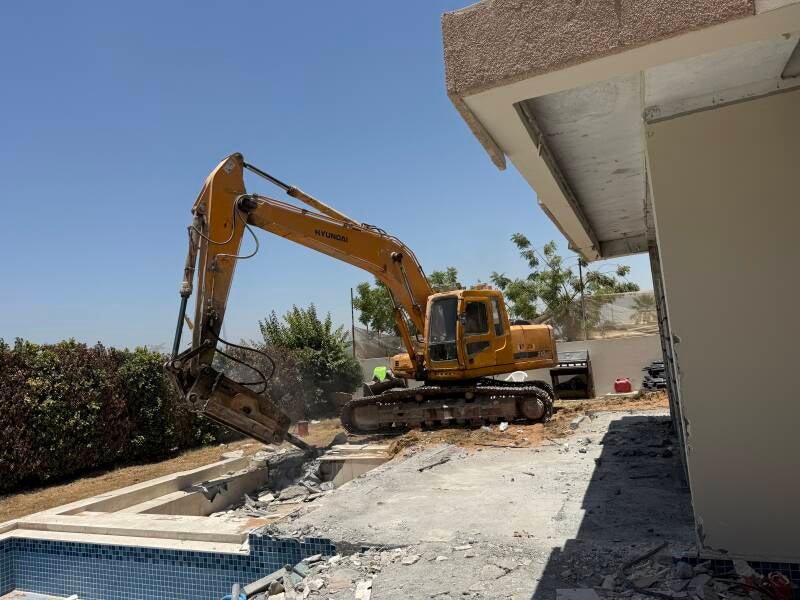
Mechanical Demolition (After Clearance)
After manual demolition:
- Required clearance (minimum 3 metres as per DM rules) is achieved
- Machines can be mobilised to site
- Remaining structure can be demolished mechanically
Dust Control and Debris Management (Very Important)
During demolition works:
- Water must be continuously sprayed to control dust
- Trucks transporting debris must be covered
- Debris must be removed continuously — not allowed to pile up
If debris is not removed regularly, the site becomes unsafe, dust levels increase, and demolition becomes difficult and risky.
Correct Demolition Sequence (Engineering Rule)
Demolition must always follow a top-to-down sequence:
- Slabs
- Beams
- Columns
Never demolish columns first. If columns are demolished directly, the entire structure may collapse — creating a high risk of serious accidents and fatalities.
This is basic but critically important demolition engineering knowledge.
Basement Demolition – Dewatering and Shoring Awareness
Basement demolition involves significant risks due to groundwater, soil pressure, and nearby structures. Dewatering and shoring are critical safety requirements — not theoretical concepts.
Dewatering
- The process of removing groundwater from the basement excavation area
- Prevents flooding, soil softening, base heave, and sudden collapse during demolition
- Dewatering systems must be installed and monitored before and throughout demolition works
Shoring
- Provides temporary support to soil and adjacent structures during demolition
- Prevents soil movement, wall collapse, and damage to nearby buildings, roads, or utilities
- Must be designed, installed, and inspected by competent personnel before demolition begins
Safety responsibilities:
- No basement demolition shall start without approved dewatering and shoring arrangements
- Engineers must verify groundwater conditions and soil stability before work begins
- Any signs of water ingress, soil movement, or shoring distress must be reported immediately
- Continuous monitoring is required during demolition activities
- Follow the approved method statement and risk assessment at all times
Dewatering and shoring are life-safety measures. Every demolition engineer must apply this knowledge on site to protect workers, nearby structures, and the public.
Safety Questions (Common in the Exam)
Expect 1 or 2 questions related to safety, covering:
Working at Height
- Proper access — scaffolding and platforms
- Guardrails and edge protection
Personal Protective Equipment (PPE)
- Helmet
- Safety shoes
- Gloves
- High-visibility vest
Safety Belt / Harness
- Mandatory when working at height
- Proper anchorage point required
- Used to prevent fall accidents
Safety is not only for exam answers — it is for real site protection.
Final Words to Engineers
Everything written above is from practical demolition experience, not copied content. These points reflect actual Dubai Municipality site practice under Dubai Municipality regulations.
If you understand the attached area concept, the building card, manual vs mechanical demolition, the correct demolition sequence, and site safety — you do not need to worry about the demolition exam.
Thank you, engineers. Best of luck.
Al Zelzal Demolition Works LLC Call / WhatsApp: 056 780 0464 www.zelzaldemolition.com
Add comment
Comments
Very useful for who preparing Dubai Municipality demolition exam accreditation G +1
This is the correct information,
Very usefull and clear.
This company is having more real time experience